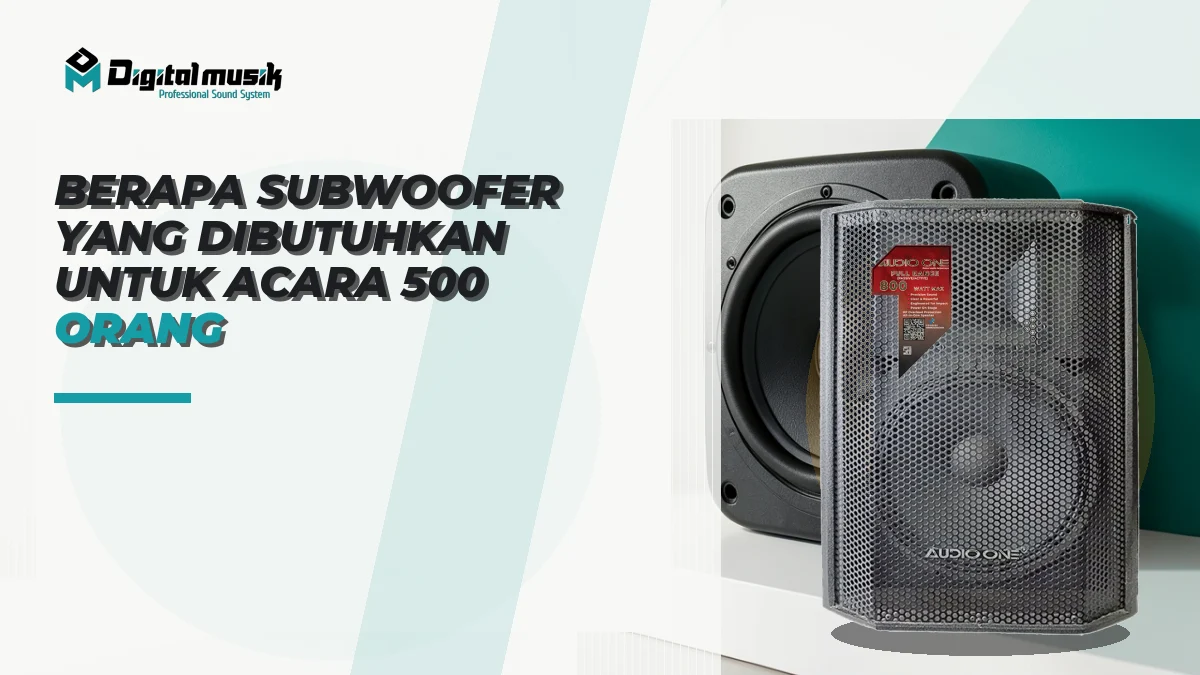
Determining the number of subwoofers for a 500-person event is often a source of confusion for audio operators. The short answer: there is no single definitive number that applies universally. Subwoofer requirements depend heavily on the area size, music genre, main system configuration (full range), and desired sound pressure level (SPL) target.
As an initial benchmark for semi-outdoor or open-air outdoor events with 500 attendees, common configurations typically range from 4 to 8 units of 15-inch or 18-inch subwoofers, depending on driver sensitivity and amplifier power. However, this number is only a rough estimate. To get accurate results, you need to evaluate the technical variables below.
Factors Determining the Number of Subwoofers
Before deciding how many units to bring or buy, understand the technical factors that influence bass requirements. Here are the main variables to consider:
- Area Size and Coverage: Are the audience spread out in a 20x25 meter square area or elongated? Subwoofers have different radiation patterns than full-range speakers. A larger area requires more bass sources to maintain sound pressure uniformity.
- Music Genre: EDM or house music requires more consistent and powerful bass energy compared to dangdut or acoustic music. Genres with low-end dominance (below 60 Hz) require more subwoofers to avoid distortion.
- Main System Configuration: The number of subwoofers must be balanced with the number of full-range speakers. If the main system is too small, adding subwoofers will not fix mid-range or high-end issues, and could instead cause frequency imbalance.
- Indoor vs Outdoor: Indoor spaces (especially those with hard acoustics) tend to amplify bass resonance, so fewer subwoofers might be needed. Conversely, open outdoor areas absorb sound energy, requiring more subwoofers to achieve the same level.
Comparison of Common Configurations
To help you map out your needs, here is a comparison of common scenarios for a 500-person event. These figures are estimates based on general industry practice and should be adjusted according to the specifications of your equipment.
| System Configuration | Estimated Number of Subwoofers | Suitable For | Technical Notes |
|---|---|---|---|
| Compact System (Portable) | 4 units (15" or 18") | Limited area, dangdut/acoustic music | Sufficient for a 15x20 m square area. Requires proper placement to avoid over-driving. |
| Standard System (Event) | 6-8 units (15" or 18") | Large area, pop/EDM music | Balanced with 6-8 full-range speakers. Provides better headroom for music dynamics. |
| High-End System (Concert) | 10-12 units (18" or 21") | Very large area, electronic/rock music | Requires separate amplifiers per channel. Focuses on linearity and bass clarity. |
Evaluation Steps Before Determining the Number
To make your decision more accurate, perform the following evaluation before finalizing the setup:
- Measure Area Size: Calculate the estimated area of seating or standing space. Do not rely solely on the number of people, as audience density affects perceived volume.
- Check Driver Specifications: Pay attention to the sensitivity (SPL @ 1W/1m) and maximum power handling of the subwoofers to be used. Drivers with high sensitivity require fewer units to achieve the same level.
- Determine Crossover Point: Ensure the crossover frequency between the subwoofer and full-range speakers is determined. It is usually in the range of 80-100 Hz. Errors here can lead to 'bully' or shallow bass.
- Consider Power Amplifier: Ensure the amplifier has sufficient headroom. Driving subwoofers with an under-powered amplifier will cause clipping and driver damage.
Common Mistakes in Subwoofer Setup
Many novice technicians make the same mistakes when setting up subwoofers for large events:
- Stacking Subwoofers in One Spot: Stacking too many subwoofers on one side of the stage can create 'dead spots' (areas without bass) on the other side of the audience. It is better to spread subwoofers symmetrically or use an array configuration if possible.
- Ignoring Phase Alignment: If the subwoofer phase is not aligned with the full-range speakers, the bass can sound thin or cancel each other out (cancellation). Use delay and phase adjustment to align the signals.
- Over-Driving: Increasing subwoofer volume excessively without considering the driver's limits. This is a primary cause of voice coil damage. Always use a limiter or compressor to protect the drivers.
When to Seek Technical Consultation?
If you are planning a large-scale event or have specific needs such as a permanent installation, technical consultation is highly recommended. One important aspect often overlooked is the subwoofer cabinet structure itself. A non-rigid cabinet or one with an unsuitable port design can reduce efficiency and damage the driver.
PT Digital Musik Indonesia can be a discussion partner for evaluating your audio system specifications. We help map out technical requirements, from driver selection, custom cabinet design, to balanced system configuration. If you are in the planning or vendor evaluation stage, prepare the following data for a more efficient discussion:
- Area size and venue type (indoor/outdoor).
- Estimated audience count.
- Main music genre.
- Specifications of existing equipment (if any).
For further discussion on audio equipment maintenance and mobility, you can read guides on when a speaker cabinet needs wheels or tips for setting up speakers for tent events that are relevant to field conditions.
FAQ
Is an 18-inch subwoofer better than a 15-inch for a 500-person event?
Not always. An 18-inch subwoofer has greater excursion and can produce higher SPL, but it is heavier and requires a larger amplifier. A 15-inch subwoofer is lighter and easier to manage for mobile events. Choose based on headroom requirements and logistical ease.
What if I only have 4 subwoofers for 500 people?
It is still possible if the area is not too large and the music is not too bass-dominant. Ensure the amplifier has sufficient headroom and use strategic placement. However, for electronic music or very large areas, 4 units might feel insufficient or easily over-driven.
Is it necessary to use active or passive subwoofers?
Active subwoofers are easier to set up because the amplifier is integrated, suitable for mobile events. Passive subwoofers offer more flexibility in amplifier selection, suitable for permanent installations or high-end systems that require more precise signal control.