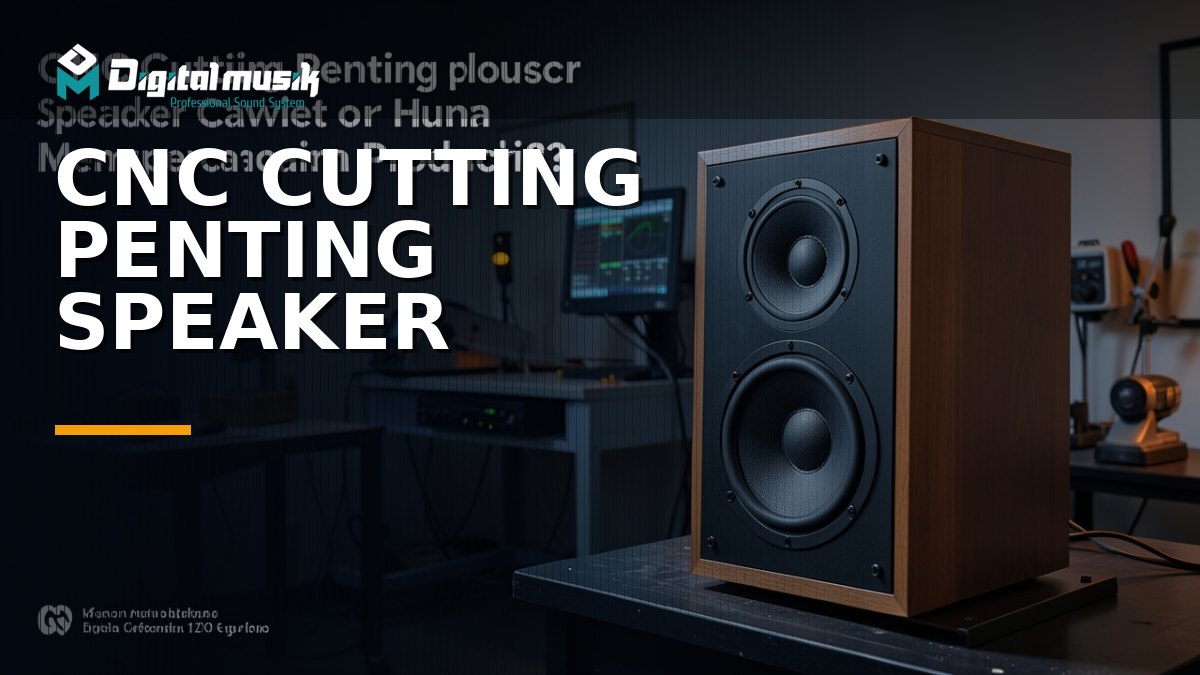
The Role of CNC Cutting in Speaker Cabinet Manufacturing: More Than Just Production Speed
In the world of professional audio, the sound quality of a speaker cabinet heavily relies on the precision of its construction. One technology often discussed in the fabrication process is CNC (Computer Numerical Control) cutting. But is the use of this CNC machine truly crucial for producing high-quality speaker cabinets, or is it merely a way to speed up the production line? This article will thoroughly explore the comparison between these two perspectives.
What is CNC Cutting and How Does It Work on Speaker Cabinets?
CNC cutting is a material cutting process using a computer-controlled machine. Materials such as plywood, MDF (Medium-Density Fibreboard), or even acrylic are cut following a pre-designed digital model. This design is uploaded into the CNC system, which then directs the blade or other cutting tools to move with high precision, producing shapes and sizes that are highly accurate according to specifications.
In the context of speaker cabinets, this precision is vital. Holes for speaker drivers, bass reflex ports, connectors, and panel joints must be cut with minimal tolerance. Even the slightest inaccuracy can affect the structural integrity of the cabinet, its airtightness, and ultimately, the acoustic performance of the speaker itself.
Advantages of CNC Cutting for Speaker Cabinets
There are several strong reasons why CNC cutting is the primary choice in modern speaker cabinet production:
- High Precision: CNC machines can cut with sub-millimeter accuracy, ensuring all components fit perfectly. This is crucial for the cabinet's airtightness, which affects bass response and overall sound clarity.
- Production Consistency: Every cabinet unit produced will have identical dimensions and details. This is very important for mass production or when you need an identical pair of stereo speakers.
- Design Complexity: CNC allows for the creation of intricate shapes or details that are difficult to achieve with manual methods. This opens up opportunities for more innovative cabinet designs, both aesthetically and acoustically.
- Material Efficiency: CNC software can optimize the cutting layout on material sheets (nesting) to minimize waste, making it more cost-effective in the long run.
- Safety and Speed: This automated process reduces the risk of operator injury and significantly speeds up production time compared to manual cutting.
Is CNC Cutting Only About Speeding Up Production?
While production speed is one of the clear benefits of CNC cutting, viewing it merely as a tool to accelerate the process is an inaccurate perspective. The quality and precision produced by CNC machines directly contribute to:
1. Cabinet Acoustic Quality
A speaker cabinet is more than just an enclosure. Its design and construction play a significant role in shaping the sound. Tight and precise joints ensure there are no unwanted air leaks, which can cause distortion at low frequencies (bass) or reduce speaker efficiency.
For example, bass reflex port designs require holes with very specific dimensions and positions. Cutting errors can alter the port's resonance characteristics, resulting in bass that is less powerful or sounds 'boomy' and uncontrolled.
2. Durability and Structural Strength
Precise panel joints, produced by CNC, allow for optimal use of adhesives and screws. This creates a stronger and more durable cabinet structure, capable of withstanding vibrations generated by speaker drivers, especially at high volumes or during transport.
3. Ease of Assembly
With precisely cut components, the assembly process becomes much easier and faster, even for complex designs. This reduces the potential for assembly errors and speeds up product completion time.
Comparison: CNC Cutting vs. Manual Methods
Let's briefly compare:
| Aspect | CNC Cutting | Manual Methods (Saw, Manual Router) |
|---|---|---|
| Precision | Very High (sub-millimeter) | Depends on operator skill, generally lower |
| Consistency | Very High | Low, each unit can be slightly different |
| Production Speed | High, especially for quantity | Slower, especially for complex details |
| Design Complexity | Capable of handling intricate designs | Limited by operator's skills and tools |
| Initial Cost | High machine investment, lower per-cut cost for quantity | Lower tool investment, high operator hourly cost |
| Acoustic Quality | Optimal potential due to precision | Potential for impairment due to imprecision |
When Does CNC Cutting Become a Crucial Choice?
CNC cutting becomes crucial in the following situations:
- Large-Scale Production: When you need dozens or hundreds of identical speaker cabinet units.
- Highly Precise Designs: For applications demanding maximum acoustic performance, such as professional recording studios, concert sound systems, or studio monitors.
- Complex Designs: If you desire unique cabinet shapes, intricate carvings, or special acoustic features that are difficult to create manually.
- Brand and Finishing Needs: For precisely embedding logos, creating special slots for branding, or ensuring a smooth and consistent finish.
Choosing the Right Fabrication Partner
Choosing the right speaker cabinet fabrication service provider is key. Companies that use CNC cutting technology typically offer:
- The ability to translate your digital designs into physical products with high accuracy.
- Flexibility in materials and finishing.
- Consistency in quality across production units.
If you are planning custom speaker cabinet production, whether for your own professional audio needs, for OEM purposes, or even for a new product line, consider the fabrication capabilities offered. Preparing design details, material specifications, and finishing requirements will be very helpful in initial discussions.
Conclusion: The Importance of Precision, Not Just Speed
So, is CNC cutting important for speaker cabinets or does it just speed up production? The answer is both, but with an emphasis on the 'importance of precision'. Speed is a bonus of the efficiency offered by this technology, but its primary value lies in its ability to create speaker cabinets with a level of accuracy and consistency that is difficult to achieve with manual methods.
For audio professionals, producers, or anyone requiring high-quality speaker cabinets, investing in CNC cutting technology in their production process is often a very wise step. It's not just about time efficiency, but about the foundation of sound quality and the durability of the final product.
If you are in the planning stage for custom speaker cabinet production and wish to discuss how modern fabrication technology like CNC cutting can support your needs, PT Digital Musik Indonesia is ready to be your discussion partner. We can help map out specification needs, materials, and production details to realize your dream speaker cabinet.