Choosing the Right Speaker: Line Array vs. Point Source
In the world of professional sound systems, choosing the right type of speaker is key to achieving optimal audio quality. Two main categories often considered are line array systems and point source speakers. Both have different characteristics and applications, making an understanding of when to use each crucial for audio operators, technicians, and event organizers.
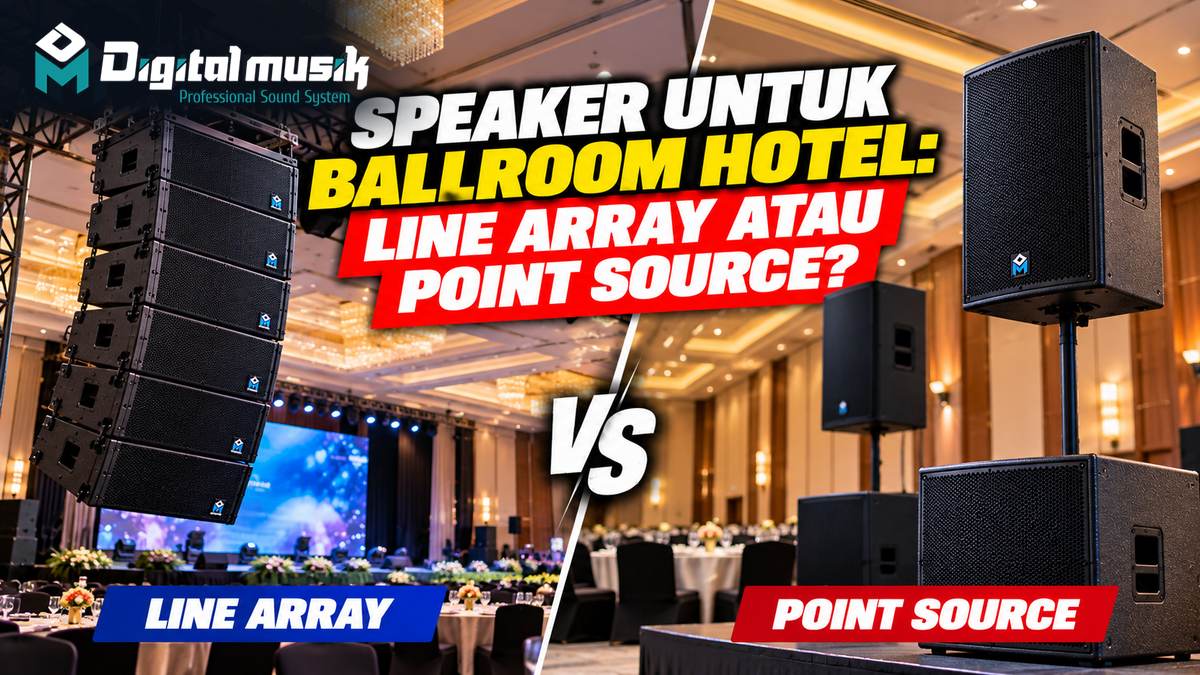
Simply put, the fundamental difference lies in how they disperse sound. Point source speakers are designed to project sound from a single source point, while line arrays consist of multiple speakers arranged vertically to create a more controlled and directed sound wave.
Characteristics of Point Source Speakers
Point source speakers, often also referred to as conventional speakers or single-cabinet speakers, are the most common type of speaker encountered. Their design typically consists of a single cabinet containing one or more drivers (woofer, midrange, tweeter) mounted at a single point or within a single unit. Their operating principle is to emit sound in all directions from that single source, with a dispersion pattern that is generally wider and conical in shape.
Advantages of Point Source Speakers:
- Placement Flexibility: Easy to place in various positions, whether on a tripod, suspended, or placed on stage.
- More Affordable Cost: Generally more economical than line array systems, making them an ideal choice for limited budgets or smaller-scale events.
- Ease of Use: Often easier to set up and operate, suitable for beginner technicians or applications that do not require complex configurations.
- Sufficient Coverage for Specific Areas: Very effective for covering areas that are not too wide or when the audience is in a relatively concentrated listening zone.
When Are Point Source Speakers Sufficient?
Point source speakers are very suitable for:
- Small to medium-scale events (e.g., meetings, presentations, small parties, band performances in cafes or bars).
- Stage monitor use for musicians.
- PA systems in churches, classrooms, or shops.
- Situations where precise and even sound coverage over a wide area is not the main priority.
- When budget is a primary consideration.
Characteristics of Line Array Speakers
A line array speaker is a system consisting of several speaker units (usually 2 to 12 units or more per side) arranged vertically and slightly angled towards each other. This arrangement is designed to create a 'linear' (straight line) sound source, which allows for much more precise control of the sound dispersion pattern, especially at high frequencies. The goal is to project sound further and more evenly across the entire listening area without too many unwanted reflections.
Advantages of Line Array Speakers:
- Long-Range and Even Coverage: Capable of reaching audiences in very large areas with consistent sound clarity from the front row to the back row.
- Superior Dispersion Control: Minimizes wasted sound directed upwards onto the stage or into unnecessary areas, reducing feedback issues and disruptive sound reflections.
- High SPL Output: Generally capable of producing higher sound pressure levels (SPL), important for large-scale events or concerts.
- Good System Integration: Designed to work harmoniously with each other, creating coherent sound waves.
When Does a Line Array Become the Primary Choice?
Line array systems are highly recommended for:
- Large-scale events such as music concerts, festivals, sporting events, or conferences in stadiums or arenas.
- Very wide or elongated listening areas, where even sound coverage is crucial.
- Situations requiring high SPL output and consistent sound clarity throughout the area.
- Applications where sound dispersion control is very important to minimize noise outside the audience area or reduce reflections.
Decision-Making Factors
Choosing between a line array and a point source is not just a matter of system size or 'luxury'. The right decision depends on several key factors:
1. Area Size and Characteristics
Large/Long Area: If you need to reach thousands of people in a stadium, open field, or large hall, a line array is almost always the superior choice. Its narrow and controlled vertical dispersion pattern allows sound to reach the back rows without excessive volume in the front rows.
Limited/Compact Area: For cafes, bars, meeting rooms, or small stages, point source speakers are usually more than sufficient. Proper placement can provide adequate coverage without the complexity of a line array system.
2. Sound Coverage Needs
Even and Far: If the target audience is spread across a very wide area and you need a high level of sound consistency from front to back, a line array excels.
Focus on Specific Area: If the audience is concentrated in one area or you only need to 'fill' sound in one zone, a point source speaker can be an efficient solution.
3. Required Sound Pressure Level (SPL)
High Volume: For rock concerts, EDM festivals, or events requiring very loud and powerful sound, a line array is often the choice due to its ability to produce high SPL coherently.
Moderate Volume: For presentations, speeches, or background music, a point source speaker of appropriate size can already provide adequate volume.
4. Budget
Line array systems, including the necessary rigging, amplifiers, and processors, generally have a much higher investment cost compared to point source systems. If the budget is limited, a correctly configured point source speaker can be a more realistic solution.
5. Installation and Operational Complexity
Line arrays require more in-depth technical knowledge for rigging, tuning, and operation. Point source speakers tend to be more plug-and-play, making them an easier choice for less experienced teams.
Conclusion: When to Choose Which?
Choosing between a line array and a point source speaker is about matching the technology to your event's specific needs. Point source speakers are reliable workhorses for various small to medium-scale applications, offering flexibility and cost-effectiveness. Meanwhile, a line array is a sophisticated and irreplaceable solution for large-scale events demanding long-range sound coverage, high SPL, and precise dispersion control.
If you are planning an event or need a specific audio system, understanding the characteristics of both types of speakers will help you make the right decision. Consider the venue size, audience number, event type, and, of course, the available budget.
For those who need a more in-depth discussion regarding professional audio solutions, whether for large-scale sound systems, custom speaker cabinets, or other audio fabrication needs, PT Digital Musik Indonesia is ready to be your discussion partner. We help map technical requirements and provide recommendations for the most suitable solutions.