Speaker Driver Placement: More Than Just Aesthetics
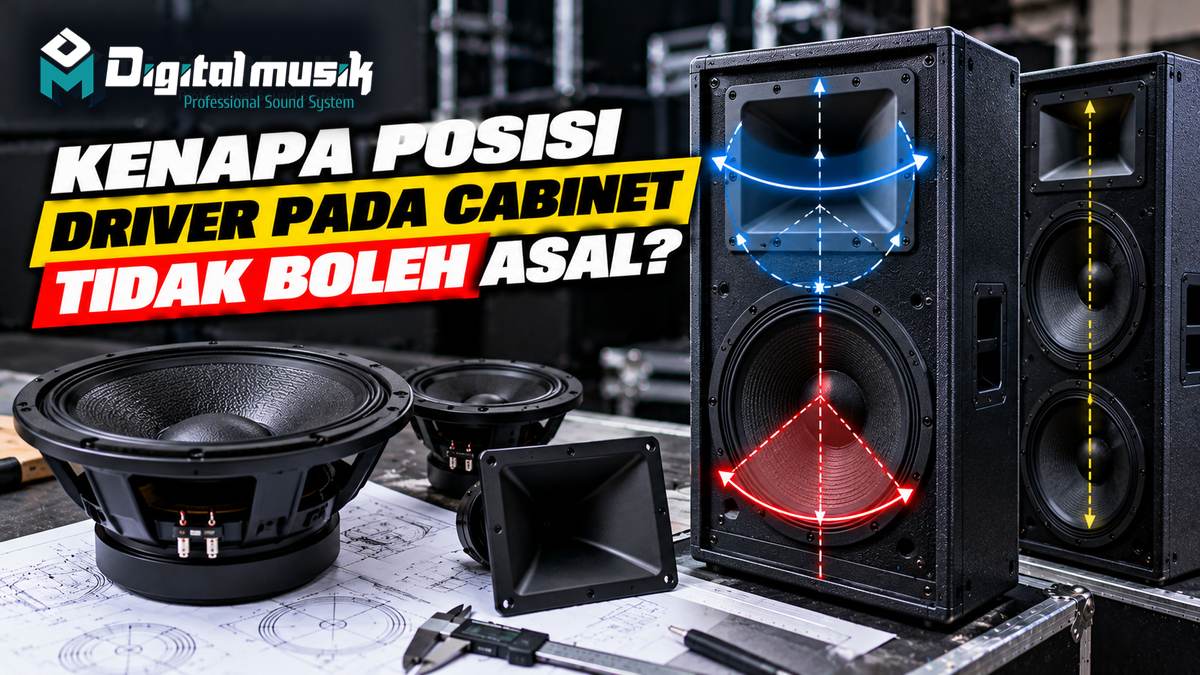
When designing or even just looking at a speaker cabinet, our attention is often drawn to the box size, its material, or even the grill design. However, there is one crucial element that often goes unnoticed: the position of the driver (speaker unit) inside the cabinet. The fundamental question that arises is: why shouldn't driver placement in a cabinet be arbitrary? The answer lies in the principles of acoustic physics that influence how sound is produced and propagates.
Improper driver placement can lead to various sound quality issues, ranging from uneven frequency response, poor sound dispersion, to unwanted sound wave interactions within the cabinet. This is not merely an aesthetic issue, but a crucial foundation for achieving optimal audio performance.
Impact of Improper Driver Placement
Every driver, be it a woofer (for low frequencies), midrange (mid frequencies), or tweeter (high frequencies), has specific sound radiation pattern characteristics. When placed inside a cabinet, the interaction between the driver and its surrounding space, as well as the interaction between the drivers themselves, becomes very important.
Some negative impacts of haphazard driver placement include:
- Sound Wave Interference: Sound waves reflected from the cabinet walls can interact with direct sound waves from the driver. If placement is not carefully calculated, this can cause *comb filtering* (peaks and troughs in the frequency response), resulting in sound that appears thin, hollow, or overly prominent at certain frequencies.
- Poor Dispersion: The sound propagation pattern from the driver can be disrupted. For example, placing a driver too close to the cabinet edge can alter how sound spreads into the room, creating an uneven listening area.
- Phase Issues: When two drivers work together (e.g., a woofer and a tweeter), the arrival time of sound from both at the listener's ear must be synchronized. Incorrect placement can cause *phase cancellation*, where sound waves from both drivers cancel each other out at certain frequencies, damaging sound clarity.
- Internal Cabinet Acoustic Performance: The space inside the cabinet is not just a container. Cabinet design, including driver placement and how the air inside interacts, significantly affects frequency response, especially for woofer drivers. Incorrect placement can reduce bass efficiency or even cause unwanted resonance.
Key Factors in Determining Driver Position
Determining the ideal driver position is not an instant task. Several technical factors must be considered:
1. Distance Between Drivers
The distance between two drivers, especially the woofer and midrange/tweeter, is crucial for minimizing *comb filtering* at the crossover frequency. Proper placement helps ensure a smooth sound transition between drivers.
2. Distance from Cabinet Edge
Placing a driver too close to the cabinet edge can affect the sound wave diffraction pattern. Generally, it is recommended to provide sufficient distance from the edge to minimize this effect.
3. Symmetry and Asymmetry
In some designs, symmetrical driver placement can help create more consistent sound dispersion. However, asymmetrical designs are sometimes used for specific purposes, such as optimizing listening area coverage.
4. Interaction with Bass Reflex Port (if any)
If the cabinet uses a bass reflex port, the driver's position relative to the port is also important for efficient bass performance.
5. Crossover Design and Driver Characteristics
Driver placement must always be considered in conjunction with the crossover design. Crossover frequency and filter slope will affect how critical the physical placement of the driver is to minimize phase issues and *comb filtering*.
How to Avoid Common Mistakes?
For those of you designing your own speaker cabinet or working with a fabrication team, there are several things to consider:
- Acoustic Design Consultation: If you do not have in-depth expertise in acoustics, it is highly recommended to consult with a professional or use speaker design simulation software.
- Pay Attention to Driver Manufacturer Recommendations: Driver manufacturers often provide recommendations regarding optimal cabinet size and driver placement for their products.
- Use Simulation Software: Tools like WinISD, BassBox Pro, or Hornresp can help predict frequency response and acoustic performance based on cabinet design and driver placement.
- Testing and Measurement: After fabrication, measuring frequency response using calibration tools is an important step to verify the design.
Understanding the importance of driver position in a speaker cabinet is the first step to achieving the sound quality you desire. Careful placement will result in clearer, more even, and more powerful audio.
If you are in the process of developing custom speakers or need further discussion regarding optimal cabinet design, PT Digital Musik Indonesia can be your discussion partner. We have a deep understanding of the professional audio ecosystem and can help map your needs for precise custom speaker cabinet fabrication.