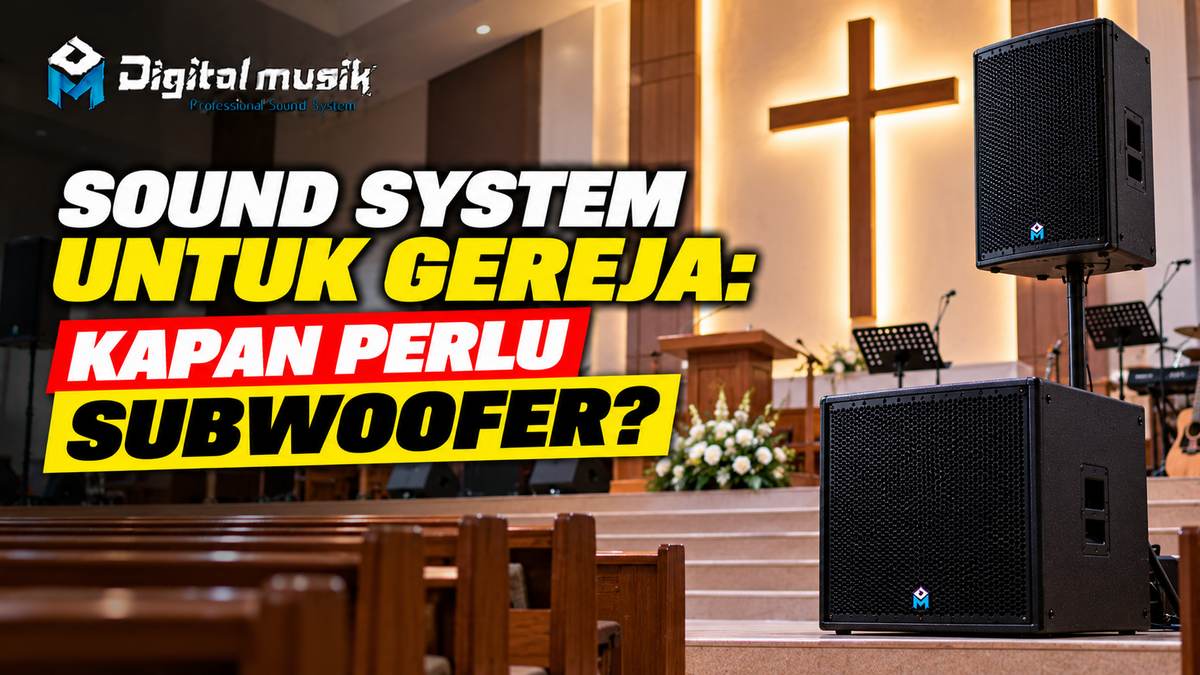
Determining Subwoofer Needs for Church Sound Systems
Choosing the right sound system configuration for a church is key to ensuring worship and other activities run smoothly without audio disruptions. One component that is often considered is the addition of a subwoofer. The fundamental question that arises is: when exactly does a church need a subwoofer in its audio system?
Generally, a subwoofer is needed when the audio system needs to reproduce low bass frequencies with adequate accuracy and power. In a church environment, this need can vary depending on the type of activities held, the room acoustics, and the dominant type of music played.
When Does a Subwoofer Become Crucial for a Church?
There are several main scenarios where the addition of a subwoofer is highly recommended for a church sound system:
1. Worship with Contemporary Music or Choirs Rich in Low Frequencies
Churches that frequently feature music with bass guitars, drums, keyboards, or choirs with deep harmonies will greatly benefit from the presence of a subwoofer. These low bass frequencies provide depth, warmth, and emotional nuance to the music. Without a subwoofer, bass sounds might lack power, sound flat, or even become distorted if the main speakers are forced to reproduce frequencies beyond their capabilities.
2. Rooms with Challenging Acoustics
Some church rooms have less than ideal acoustic characteristics, such as too much reflection (reverb) or dead spots. Strategically placed subwoofers can help fill in low-frequency gaps in these areas, creating a more even audio experience throughout the congregation. However, placing subwoofers in rooms with a lot of reverb needs to be done carefully so as not to worsen the condition.
3. Special Events and Concerts
For special events such as spiritual music concerts, Christmas, Easter celebrations, or seminars with intense music sessions, the addition of a subwoofer will significantly improve audio quality. Subwoofers can provide the punch and depth that are often characteristic of professional music performances, making the audience feel more energy and atmosphere.
4. Need for Sound Effect Reproduction
In some worship services or short dramas, sound effects involving low frequencies, such as rumbling, explosions, or nature sounds, may be needed. Subwoofers are the most effective component for reproducing these sounds with the desired impact.
5. Desired Quantity and Quality of Bass by the Congregation
Sometimes, the desire of the congregation or audio team to experience a richer and 'fuller' audio experience becomes a consideration. If the current main speakers feel lacking in their bass reproduction, adding a subwoofer can be a solution to increase listener satisfaction.
Factors to Consider When Choosing a Subwoofer for a Church
Choosing the right subwoofer involves several considerations:
- Room Size: Churches with large congregations or spacious rooms may require subwoofers with larger driver sizes (e.g., 15 or 18 inci) and higher power. Smaller rooms might be sufficient with a 12 inci subwoofer.
- Type of Music: Music that heavily relies on bass (such as contemporary praise music with many electronic instruments) will benefit more from a powerful subwoofer.
- Existing Main Speakers: Ensure that the chosen subwoofer can integrate well with the already installed main speakers. The correct crossover frequency needs to be set to avoid frequency overlap or gaps.
- Placement: The placement location of the subwoofer significantly affects bass sound distribution. Consult with an audio expert to determine the best position in your church.
- Mobility Needs: Is the sound system permanent or does it need to be moved for certain events? There are active subwoofers (with integrated amplifiers) which are more compact, and passive subwoofers which require an external amplifier.
When Might a Subwoofer Not Be So Important?
Not all churches absolutely require a subwoofer. If your church:
- Primarily uses traditional liturgical music that does not heavily rely on deep bass frequencies.
- Has a room with excellent acoustics and main speakers that are already capable of reproducing bass frequencies sufficiently for the audience's needs.
- Has budget or physical space limitations for adding equipment.
- The main focus is on vocal clarity and mid-to-high frequency instruments.
In these cases, focusing on the quality of the main speakers, microphones, and mixer might be a higher priority.
Ensuring Optimal Audio Quality
The addition of a subwoofer should be part of a comprehensive audio system plan. Its purpose is to complement, not replace, the function of the main speakers. Proper integration between the main speakers and the subwoofer, as well as accurate crossover settings, are crucial for achieving balanced and clear sound results.
If you are planning to add or upgrade your church's sound system and are unsure whether a subwoofer is the right solution, it is important to map out your needs in detail. Consider the type of worship, the music used, the room characteristics, and the congregation's expectations.
To get more specific guidance tailored to your church's conditions, discuss your needs with a professional audio expert. They can help analyze room acoustics, evaluate existing speakers, and recommend the most suitable system configuration, including determining the type and number of subwoofers required.
Prepare information regarding:
- The size and layout of your church room.
- The types of music and audio activities most frequently performed.
- The average number of congregants present.
- The audio equipment you already own (main speakers, mixer, amplifier).
- The budget available for adding to the audio system.
This information will be very helpful in designing an optimal audio solution for your church.