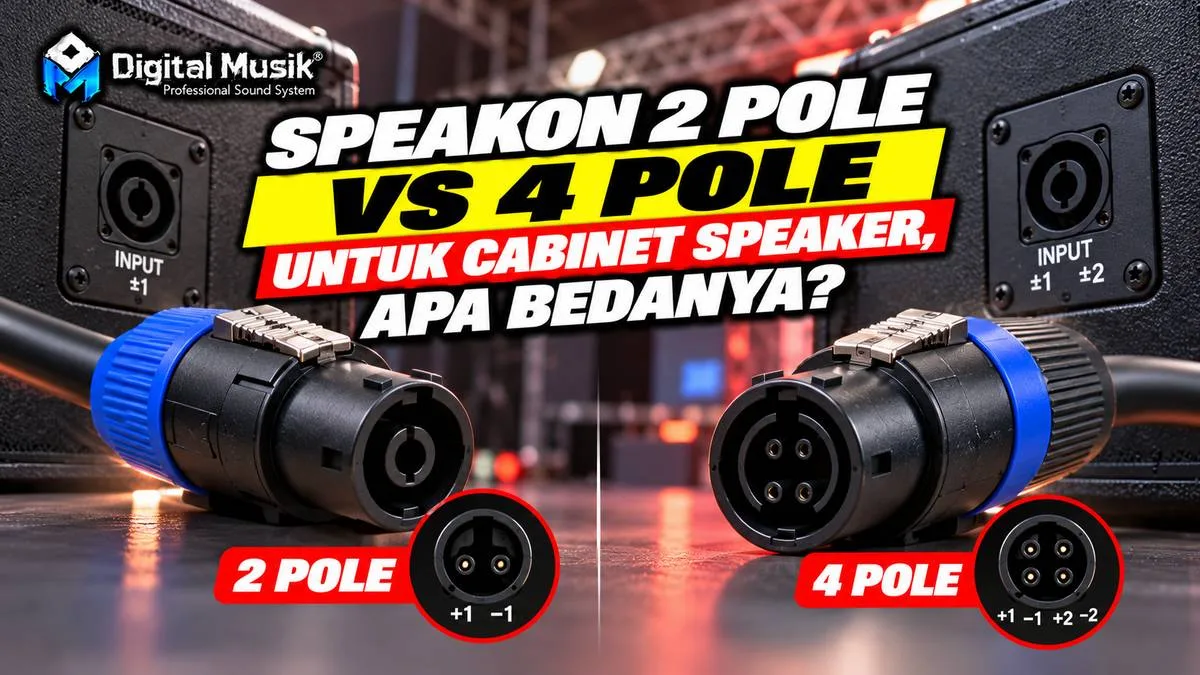
Choosing the Right Speakon Connector: 2 Pole vs 4 Pole
In the world of professional audio, Speakon connectors have become the industry standard for connecting amplifiers to passive speakers. However, for some, especially those new to this field, a question might arise: what is the difference between Speakon 2 pole and 4 pole, and which one should be used for a speaker cabinet?
Understanding these differences is crucial to ensure a safe, efficient, and optimal connection for your sound system. This article will thoroughly explore the fundamental differences between these two types of connectors, helping you make the right decision.
What is a Speakon Connector?
Before delving into the comparison, let's first understand what a Speakon connector is. Developed by Neutrik, Speakon connectors are audio connectors specifically designed for speaker cables. Their advantages include a secure twist-lock system (preventing accidental disconnection), the ability to handle high power, and a robust and reliable design for professional use.
Fundamental Differences: 2 Pole vs 4 Pole
The main difference between Speakon 2 pole and 4 pole connectors lies in the number of pins or terminals available within them, which directly affects their function in an audio system.
Speakon 2 Pole
A Speakon 2 pole connector has two terminals: one for the positive signal (+) and one for the negative signal (-). This connector is typically used for simpler applications, such as:
- Connecting one amplifier to one passive (full-range) speaker.
- Audio systems that do not require frequency signal separation (e.g., not using separate passive crossovers or bi-amping).
In terms of wiring, the terminals on a 2 pole connector are usually connected as follows:
- Terminal 1+ connects to the speaker's positive.
- Terminal 1- connects to the speaker's negative.
Speakon 4 Pole
A Speakon 4 pole connector has four terminals, allowing for two independent signal circuits. This is its main advantage and makes it more flexible for various sound system configurations:
- Bi-amping: Allows one amplifier (with a 4 pole output) to send separate signals to the low-frequency driver (woofer) and high-frequency driver (tweeter) within a single speaker cabinet, each through different terminals.
- Stereo to Dual Mono: Can be used to send two separate audio channels (e.g., left and right) through one cable to two different speakers (each using one circuit from the 4 pole connector).
- Systems with Subwoofers: Sometimes used to connect an amplifier to a subwoofer that has dual inputs or a special configuration.
Common wiring for a 4 pole connector is:
- Terminals 1+ and 1- for the main driver (e.g., woofer).
- Terminals 2+ and 2- for the second driver (e.g., tweeter in a bi-amp system, or the second channel in a stereo setup).
A 4 pole connector can be used for 2 pole applications. This is done by only using terminals 1+ and 1-, just like on a 2 pole connector. This provides flexibility as one type of cable and connector can accommodate both needs.
When to Use 2 Pole vs 4 Pole?
The decision between using a 2 pole or 4 pole connector largely depends on your speaker cabinet design and how you plan to connect it to the amplifier.
Choose 2 Pole If:
- Your speaker cabinet is a simple full-range type with one driver (or multiple drivers connected in parallel/series within an internal passive crossover).
- You only need one signal channel from the amplifier to the speaker.
- Budget is a primary consideration and you do not require the flexibility of bi-amping or dual-channel.
Choose 4 Pole If:
- Your speaker cabinet is designed for bi-amping or tri-amping (has separate inputs for woofer and tweeter).
- You want to use one cable to send two separate audio channels (e.g., stereo to two speakers).
- You want future flexibility to upgrade your system to bi-amping without replacing cables or connectors.
- You are using an amplifier that has a 4 pole output and want to utilize its capabilities.
Advantages of Using 4 Pole for Flexibility
While 2 pole connectors are sufficient for many applications, using 4 pole connectors on your speaker cabinets and cables offers significant advantages in terms of flexibility. You can easily configure your system for bi-amping if needed, or continue to use it as a standard 2 pole connection. This means that an initial investment in 4 pole connectors can save costs and complexity later if you decide to upgrade your system.
Other Important Considerations
In addition to the number of poles, make sure you also pay attention to:
- Speaker Cable Quality: Use cables with an appropriate size (gauge) to handle your amplifier's power and the cable's length. Cables that are too thin can cause power loss and reduce sound quality.
- Connector Quality: Choose Speakon connectors from reputable manufacturers to ensure a solid connection, durability, and consistent performance.
- Amplifier Compatibility: Ensure your amplifier's output matches the speaker configuration (e.g., if the speaker is designed for bi-amp, your amplifier must also support it).
When to Seek Professional Consultation?
Choosing the right connector is an important first step in building or optimizing your audio system. If you are assembling custom speaker cabinets, planning a bi-amping system, or simply want to ensure all components are connected correctly for the best performance, discussing with a professional audio expert can be very helpful.
PT Digital Musik Indonesia has experience in the professional audio ecosystem. We can be your discussion partner in understanding technical specifications, component selection, and even custom fabrication for your audio needs. If you are planning a custom speaker cabinet project or need consultation regarding audio system integration, do not hesitate to contact us.
Conclusion
The difference between Speakon 2 pole and 4 pole lies in the number of signal circuits they can carry. 2 pole connectors are suitable for simple full-range speaker connections, while 4 pole offers more flexibility for applications such as bi-amping or sending two audio channels. Choosing 4 pole is often a wise investment for future flexibility, even if you are only using it as a 2 pole connection currently.
Ensure you choose connectors and cables that match your system's power requirements and configuration to achieve optimal and safe audio performance.
Frequently Asked Questions About Speakon 2 Pole vs 4 Pole
Can I use a 4 pole Speakon cable for a 2 pole speaker?
Yes, you can. A 4 pole connector can be used for 2 pole applications by only connecting terminals 1+ and 1-. This is a significant advantage as it provides flexibility.
Is a 4 pole Speakon better than a 2 pole?
Neither is inherently 'better'. A 4 pole connector is more versatile because it supports two signal circuits, which is important for bi-amping or stereo configurations. For simple full-range speakers, 2 pole is sufficient.
How do I know if my speaker cabinet needs 2 pole or 4 pole?
Check the connector panel on the back of your speaker cabinet. If there is only one pair of terminals (usually marked with + and - or 1+ and 1-), then the speaker is designed for a 2 pole connection. If there are two pairs of terminals (e.g., 1+ & 1- and 2+ & 2-), then the speaker supports a 4 pole connection, often for bi-amping.